





⚡Key Takeaways
- A strong embedded analytics architecture gives your SaaS users fast, self-service insights directly inside your product, without sending them to external business intelligence tools
- The best setup includes a multi-layer multi-tenant architecture, a scalable data layer, secure data isolation, and fully embeddable visual components
- A purpose-built platform like Qrvey removes the need to build everything yourself, cutting engineering workload, cloud costs, and time to market
Building analytics always feels harder than it should because most SaaS teams start strong, only to get buried under pipelines, permissions, and dashboards that refuse to scale.
The truth is embedded analytics architecture is broken when it’s treated as a bolt-on feature instead of a core product layer. We’ve seen teams cut development time in half just by rethinking how data flows, tenants are isolated, and how user experiences are personalized.
This guide shows you why architecture is the real advantage and how modern SaaS companies are rethinking data lakes, semantic layers, and multi-tenant design.
What Is Embedded Analytics Architecture?
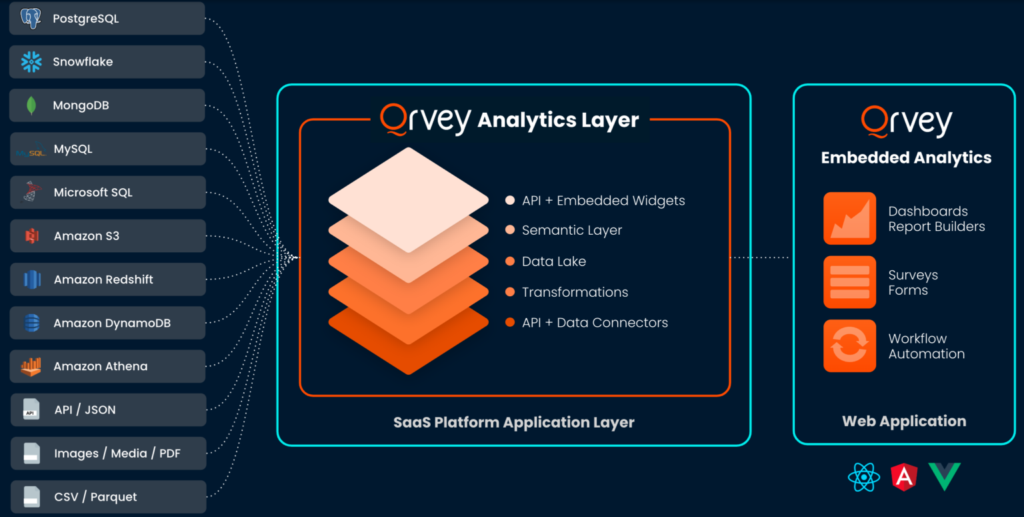
Embedded analytics is the collection of systems, layers, and connections that let you pull data from various sources, transform it into something meaningful, and display it directly in your application where your business users actually work.
Unlike traditional business intelligence platforms that exist as separate tools, embedded analytics lives inside your product.
When implemented through solutions like Qrvey or similar modern platforms, the architecture leverages components that seamlessly integrate into your products. This includes embeddable widgets, custom APIs, semantic modeling layers, and high-performance data engines that scale to support any type of data complexity and size.
Embedded reporting becomes seamless when the architecture is designed with multi-tenant database architecture principles from day one.
Benefits of Well-Designed Embedded Analytics
More than just charts, the right embedded analytics architecture shapes how customers feel about your product.
Improved User Experience
A contractor managing roofing projects wants to see project profitability and material costs right there in their workflow, not by exporting spreadsheets or logging into a separate analytics tool.
This is exactly why JobNimbus, a CRM platform for contractors, integrated Qrvey’s embedded analytics into its system.
Well-designed embedded analytics architecture eliminates context switching. Users stay in your application while accessing the insights they need. The experience feels seamless because you control the design, the interactions, and how everything integrates with existing workflows.
Cost-Effective Advantage
To build analytics in-house, you need data engineers who understand pipelines, frontend developers familiar with visualization libraries, and ongoing maintenance as data grows.
Multi-tenant architecture changes the economics completely. Instead of provisioning separate infrastructure for each customer, you share resources across all tenants with logical security boundaries.
Global K9 Protection Group saved 60% on analytics costs by moving from QuickBase to a multi-tenant system with Qrvey.
The savings came from shared infrastructure and not needing specialized teams to build every component from scratch.
Faster Implementations
Say sales promises analytics to close a deal, and engineering estimates nine months to deliver. Pre-built architecture collapses that timeline.
Instead of building data connectors, security models, visualization libraries, and caching mechanisms yourself, you implement components that already exist. Onboarding new customers becomes simple because the foundations already exist; you’re configuring data sources and permissions rather than provisioning servers.
Consistent Updates
Traditional business intelligence setups create a maintenance nightmare. You build a dashboard for Customer A, then Customer B wants something similar but slightly different, and soon you’re managing 50 custom implementations.
Embedded analytics architecture with proper multi-tenant database architecture lets you push updates to all customers simultaneously. Your customers get access to innovations like natural language queries and predictive analytics without you rebuilding anything custom.
Secure Multi-Tenant Data Isolation
The biggest concern with multi-tenant architectures is straightforward: what if Customer A somehow accesses Customer B’s data?
Proper architecture solves this through layers working together. Tenant IDs tag every piece of data, row-level security filters queries automatically at the database level, and attribute-based access control ensures users only see what they should.
JobNimbus implemented this approach and achieved 70% user adoption among enterprise clients who needed strict security guarantees. The system creates logical walls between tenants while sharing physical infrastructure, making it as secure as separate databases but far cheaper to operate.
Want to see how this architecture delivers analytics 10x faster than building in-house?

Core Components of an Embedded Analytics Architecture
Every system needs five layers working together. Miss one and you create bottlenecks or security gaps.
Data Ingestion Layer
This is where information enters your system from everywhere customers keep data. The ingestion layer connects to data warehouses like Snowflake, cloud data platforms, transactional databases, APIs, and uploaded files.
For modern SaaS applications, you need connectors that work with cloud data warehouses and data lakes without custom ETL code for every source. The goal is a unified pipeline that ingests data regardless of where it lives.
Storage & Modeling Layer
Once data arrives, you need somewhere to store it and a way to make it queryable. This includes your data warehouse, data lake, or hybrid architecture. Raw data sits in the Persistency layer while the Modeling layer transforms it into structures that make sense for analytics.
Qrvey’s built-in data lake handles this automatically and lets you create custom models per tenant when needed, something that becomes critical when different customers need different fields or calculations.
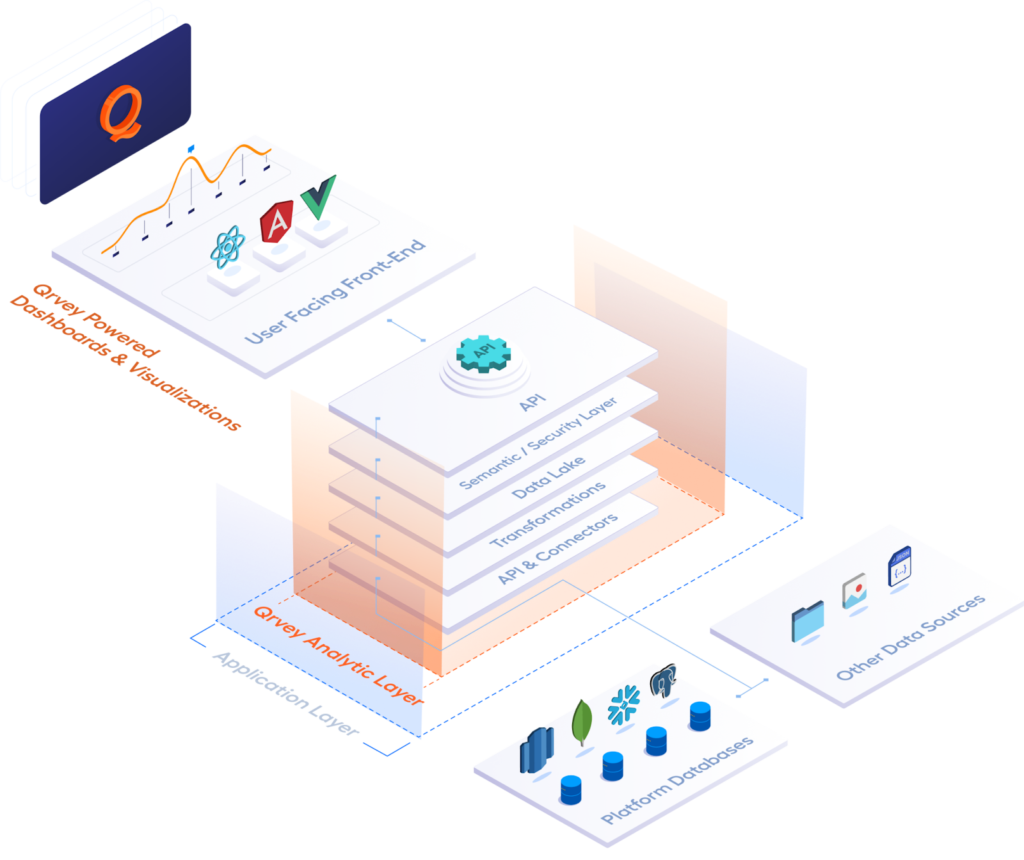
Security & Access Control Layer
How do you ensure 1,000 customers using shared infrastructure never see each other’s data?
Modern platforms generate security tokens on the fly that carry tenant and user context, eliminating duplicate user management. This is the difference between security that works in theory and security that survives production load with thousands of concurrent users.
Analytics & Visualization Layer
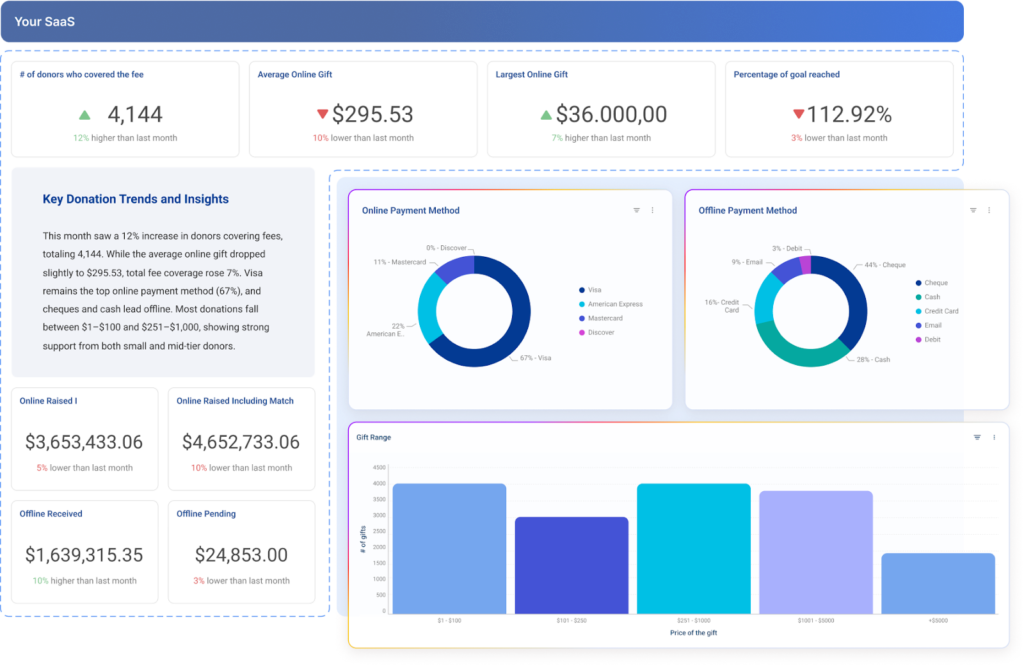
This is what users see and interact with: dashboards, reports, charts, and interactive applications.
For instance, Global K9 Protection Group distributes sophisticated heatmaps and compliance reports to over 120 airport locations, all feeling native to their K9 Analytics platform through Qrvey’s embeddable components.
The layer needs to support self-service scenarios where business users build their own dashboards using drag-and-drop tools. Qrvey’s visualization components embed as JS-based widgets that match your design system without CSS battles, making customer reporting feel like a native feature instead of a bolted-on tool.
API & Integration Layer
APIs are the glue holding everything together. This layer exposes interfaces that let you embed visualizations, trigger data refreshes, manage permissions, and handle interactions programmatically. It needs to support real-time processing for operational dashboards and batch operations for large report generation.
Single Tenant vs Multi-Tenant Embedded Analytics Architecture
Choosing between these approaches fundamentally changes how your analytics scales, what it costs, and how much flexibility you maintain.
Single-tenant means each customer gets their own isolated instance: separate databases, servers, and application code. Multi-tenant architecture means all customers share infrastructure with logical separation enforced through tenant IDs and security rules.
| Factor | Single-Tenant | Multi-Tenant |
|---|---|---|
| Cost per Customer | High, dedicated infrastructure each time | Low, shared resources with marginal cost |
| Scalability | Requires provisioning per customer | Automatic scaling across shared pool |
| Customization | Unlimited but creates maintenance burden | Configuration-driven flexibility |
| Security Model | Physical isolation | Logical isolation with row-level filtering |
| Updates | Must upgrade each instance individually | Single update applies everywhere |
| Time to Onboard | Days to weeks | Minutes to hours |
Cost & Scalability
With single-tenant setups, each new customer requires dedicated infrastructure and maintenance. Your 100th customer costs roughly the same as your first because you’re provisioning separate resources every time.
Multi-tenant embedded analytics architecture changes the economics since resources are shared across all tenants, so adding customers has near-zero incremental overhead.
Global K9 Protection Group demonstrated this by achieving 60% cost savings when they moved from their single-tenant QuickBase system to a multi-tenant approach with Qrvey.

The savings came from eliminating duplicate infrastructure while maintaining the same security and performance standards.

Customization
Single-tenant lets you modify anything per customer, but you’re essentially running multiple products. Multi-tenant architectures handle customization through configuration.
For instance, Qrvey lets you create custom data models per tenant within the same multi-tenant database architecture, so you address unique requirements without maintaining separate codebases. One team maintains one system while still meeting individual customer needs.
Security & Control
Single-tenant offers physical separation, so if there’s a breach, only one customer is affected.
Multi-tenant architecture uses sophisticated logical separation where every database row includes tenant IDs, and queries automatically apply filters. Modern platforms built on AWS and Azure have proven this approach can be just as secure as physical separation when implemented correctly.
Use our free ROI calculator to compare costs between building in-house and buying multi-tenant platforms like Qrvey
Common Challenges and How to Address Them
Even with solid embedded analytics architecture, you’ll hit obstacles that slow deployment or frustrate users.
- Challenge: Query Performance Degrades as Data Grows
Your dashboards load instantly with 10,000 rows, but crawl at 10 million. Business users complain about wait times.
Solution: Implement caching mechanisms that store frequently accessed results, use columnar storage in your data warehouse, and leverage real-time processing only when necessary.
- Challenge: Customers Want Customization That Breaks Multi-Tenancy
Customer A needs metrics, Customer B doesn’t care about them. Customer C wants a completely custom data visualization.
Solution: Build structured flexibility into your modeling layer. Qrvey lets you alter data models per tenant, add custom fields, and create tenant-specific views while maintaining shared infrastructure.
Choosing the Right Embedded Analytics Solution
You’ve decided not to build embedded analytics in-house. Now you’re evaluating platforms and drowning in vendor marketing. Here’s what actually matters based on your architecture needs.
Full-Stack Data Management
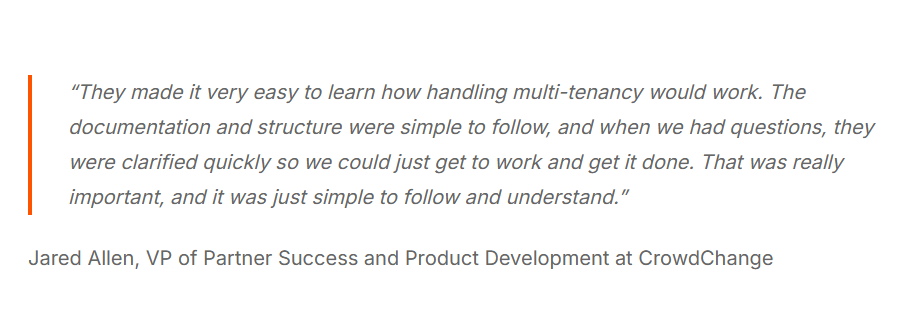
Full-stack analytics means more than charts. It includes data connectors, a semantic layer, secure, scalable storage, and visuals that work together. CrowdChange chose Qrvey because it unified data collection, automation, and analytics in one platform, eliminating complex tool stitching and speeding delivery of modern, self-service insights.
White-Label Customization and UX Control
If your embedded analytics looks like a separate tool pasted into your app, you’ve failed.
You need complete white-label capable software with no vendor branding and full control over user interactions. The interface should feel like you built it, not like you embedded someone else’s product.

This is critical for competitive differentiation. Your analytics become a feature customers associate with your brand, not with an underlying platform they could theoretically use elsewhere.
AI and Automation Capabilities Built-In
Static dashboards are table stakes now. Your customers expect intelligent features.
Look for platforms with AI features like natural language queries, where business users ask questions conversationally instead of building filters manually.
Qrvey includes Smart Analyzer for conversational data storytelling and an AI Chart Builder that generates visualizations from natural language descriptions.
See how to use GenAI to create charts fast in Qrvey in this clickable demo.
These features differentiate your product without requiring you to build chat agents or natural language query capabilities yourself.
Curious how quickly you could deploy embedded analytics versus building it? Check out our ROI calculator to see the timeline and cost comparison based on your specific requirements.
Best Examples of Embedded Analytics Architecture
Seeing how other companies implemented embedded analytics architecture makes the concepts concrete.
Efficiency and Customer Experience Gains for Automotive Dealerships
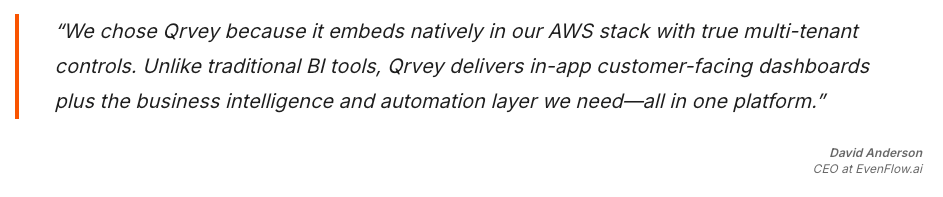
EvenFlow’s solution helps dealerships reduce inefficiencies that can reach up to 30% of operational capacity, transforming how teams manage demand, resources, and customer satisfaction.
EvenFlow not only enhanced its analytics capabilities but also reimagined how dealerships uncover operational insights—leading to measurable improvements in efficiency, customer experience, and revenue.
Association Management at Scale
Impexium, built on AWS using Lambda, DynamoDB, and OpenSearch, needed embedded analytics matching their serverless architecture. Qrvey unified data collection, automation, and analytics in one platform. New associations are now onboard in hours with full analytics capabilities, empowering customers to perform self-service analysis and enabling faster feature deployment than competitors using traditional tools.
Contractor CRM with Flexible Analytics
JobNimbus faced enterprise client churn due to rigid reporting tools. Integrating customer-facing analytics through Qrvey gave them a scalable, self-service system. The architecture unified data sources without heavy transformations and enabled non-technical users to build dashboards using drag-and-drop tools while maintaining strict security. Within months, they achieved 70% user adoption and reduced enterprise churn significantly.
These patterns repeat: multi-tenant architecture that scales efficiently, self-service capabilities reducing support burden, and seamless embedding making analytics feel like a core feature.
Best Practices for Scaling Embedded Analytics
Scaling from 10 to 1,000 customers without breaking your embedded analytics architecture requires planning ahead.
Design for multi-tenancy from day one
- Start with tenant IDs in every data model and implement row-level security at the database level
- Retrofitting single-tenant systems later is expensive and time-consuming
Enable self-service to reduce bottlenecks
- Let business users create their own views using no-code builders instead of manually building every dashboard
Plan for data growth with tiered storage
- Recent data needs sub-second performance, while historical data can tolerate slower retrieval
- Implement automatic lifecycle management between tiers based on access patterns

The Future is Multi-Tenant
Multi-tenant SaaS adoption continues accelerating across all software categories. The efficiencies are proven, and forward-thinking SaaS companies are primed to reap similar benefits.
As advanced analytics permeates daily workflows via embedded apps, multi-tenant architecture unlocks immense potential whether you are building or leveraging these next-gen reporting tools.
See How Qrvey Helps SaaS-Grade Analytics Architecture
You understand the components and benefits of multi-tenant embedded analytics architecture. The question is whether to build or buy.
Qrvey eliminates this dilemma by giving you complete architecture that deploys in weeks. You get the full stack: data ingestion from any sources, a data lake optimized for multi-tenant analytics, semantic modeling tools, white-label visualization, and APIs making everything embeddable.
Want to see how this could work in your application? Demo Qrvey today.


David is the Chief Technology Officer at Qrvey, the leading provider of embedded analytics software for B2B SaaS companies. With extensive experience in software development and a passion for innovation, David plays a pivotal role in helping companies successfully transition from traditional reporting features to highly customizable analytics experiences that delight SaaS end-users.
Drawing from his deep technical expertise and industry insights, David leads Qrvey’s engineering team in developing cutting-edge analytics solutions that empower product teams to seamlessly integrate robust data visualizations and interactive dashboards into their applications. His commitment to staying ahead of the curve ensures that Qrvey’s platform continuously evolves to meet the ever-changing needs of the SaaS industry.
David shares his wealth of knowledge and best practices on topics related to embedded analytics, data visualization, and the technical considerations involved in building data-driven SaaS products.
Popular Posts

Why is Multi-Tenant Analytics So Hard?
BLOG
Creating performant, secure, and scalable multi-tenant analytics requires overcoming steep engineering challenges that stretch the limits of...

How We Define Embedded Analytics
BLOG
Embedded analytics comes in many forms, but at Qrvey we focus exclusively on embedded analytics for SaaS applications. Discover the differences here...

White Labeling Your Analytics for Success
BLOG
When using third party analytics software you want it to blend in seamlessly to your application. Learn more on how and why this is important for user experience.
